How Sweet it is

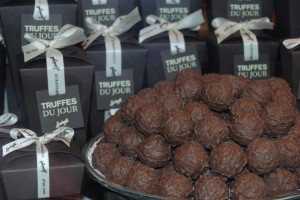
Switzerland is the land of chocolate. Did you know that the average Swiss person consumes over 26 pounds of chocolate every year?! We always have a few bars of wonderful chocolate in the kitchen. I’m on a mission to try every kind of chocolate in the amazing aisle at the grocery store. But this week, we had a chance to go a little deeper into Swiss chocolate culture.

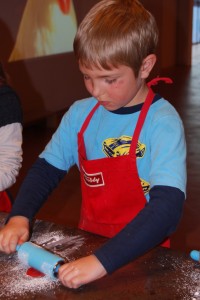
On Wednesday afternoon, when the kids are not in school, I took them to the Kambly factory. Kambly is a Swiss company that is best known for their cookies. At their factory, they have a special program for kids to make a cookie creation. I had registered Emily and James, so when we arrived they received an apron and got to work. I was expecting them to churn out a batch of cookies, but no. They made a work of eatable art, complete with a cookie base, cake ball snowman, chocolate tree, and marzipan decorations. At the end, after over two hours of hard work, they didn’t want to eat it! (You can see their finished creations in our gallery). Fortunately, there were plenty of Kambly cookies laid out to sample, so we all spoiled our supper before returning home.
The next day was my birthday, and I had another treat for my sweet tooth. Recently, I discovered a great blog called “My Kugelhopf” written by an American living in Zurich who loves sweets, chocolate and traveling. It’s perfect for me! She gives a tour called “Sweet Zurich,” so I signed up. Joe’s gift to me was staying home with the kids for the day (he worked late a couple of nights to make up for it). So, I grabbed my book and my camera and hopped on the train.
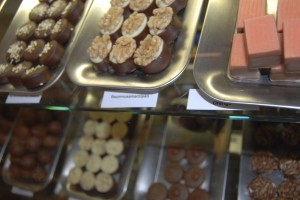
This tour was deliciously sophisticated, like a chocolate appreciation class. We walked around the beautiful old town neighborhoods of Zurich visiting small, boutique chocolate and pastry shops. We learned about the different tropical regions the cocoa beans come from, the ingredients and process involved with making chocolate, and how different decisions affect the taste and quality of the final product. I tasted a dark chocolate with ginger and orange, a white chocolate with lime, an unconched chocolate with raisins (and learned what “conching” is!), among many other things. At a specialty cupcake shop, they even had a candle in a cupcake for my birthday.
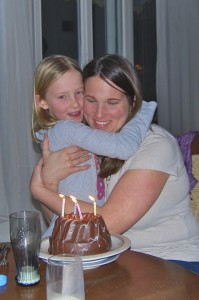
Before I knew it, I was back on the train, but there was one more sweet treat on my list. After reading the blog and meeting the author, I wanted to try a Kugelhopf. I stopped at the store on the way home and picked one out. I opted for the less traditional chocolate kugelhopf (or gougelhof in this area.) At home we had a little celebration with the cake and a few cards and presents. I feel very blessed, and very full. I think I need to eat salads for the next week!

See all the sweet pictures here.
Over the Hump

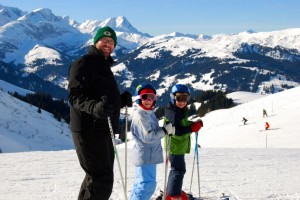
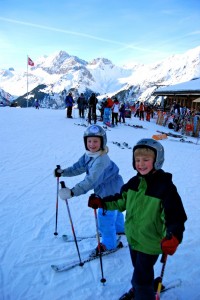
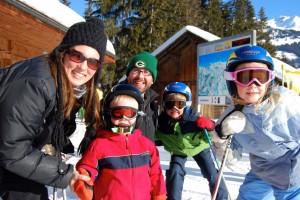
This past weekend we were lucky enough to be invited to stay with some friends of ours who have a house in the mountain town of Lenk, during which we got “over the hump” both physically and metaphorically. See, we have been debating about whether our family is really cut out for skiing at this stage. Emily and James have had virtually no experience, and our first effort over Christmas was not enjoyable for anyone. But, the family we stayed with has been coming to this valley and skiing their whole lives. So, we had no choice but to go with the flow.

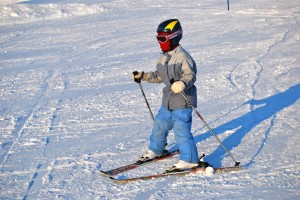
On Saturday morning we all got geared up and headed over to the first ski area. They even had skis in Henry’s size and insisted he should suit up with the rest of us. We got to the top of the lifts, and skied down the first hill. I was holding Henry, who was screaming the whole way down. He was pretty much done for the day. But everyone else took off with enough adults to help. After lunch I got to ski down with Emily (holding her between my legs for most of a medium run) until we got to the kids area or “bunny hill,” as my family calls it. We skied for a couple more hours, with the adults taking turns staying with the kids. This was far longer than we have ever managed before. By the end of the day, the kids had made a lot of progress, but we were all pretty exhausted. Fortunately, there was a gondola to take us back down the hill and a great swimming pool complex where Joe and I took all the kids to unwind.

That night, another family joined us at the house, so there were two Swiss families with spouses from Sweden and Namibia and us. Everyone mostly spoke English, but we understood what they said in Swiss German as well. They complimented our kids, and even us, on our ability with the language. We kept up with a conversation about Swiss cultural quirks and compared the virtues of the two primary Swiss grocery store chains. Though it seems small, I felt like we had really gotten over a cultural “hump” and were no longer the outsiders.

On Sunday, we were off again. After a scary ride up an icy mountain road on which the direction of the one-way traffic changes every half hour, we made it to the ski area on the other side of the valley. I stayed in with Henry and played in the snow for most of the morning, and Joe was able to take both Emily and James on his own and help them as they skied independently. This was huge! They had clearly gotten over a critical hump in their ability, and they started to become more confident.

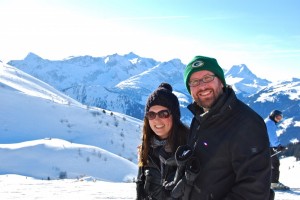
After lunch, Lorenz offered to stay with our kids so Joe and I could explore a bit. We literally went over the mountain and down to Adelboden in the valley on the opposite side. We humiliated ourselves on a black run that was directly below one of the busiest chair lifts, but fortunately no one was hurt, so we’ll just gloss over that. Otherwise, we had a wonderful time and returned to our kids just as the lifts were starting to close down. The mountain had mostly cleared out, and this time there was no gondola to ride down. The only way to get to the car was to ski down the mountain.

Lorenz was nice enough to carry Henry down (we didn’t even bother to put his skis on anymore). Joe and I followed with the other kids, and I am proud to say that they did a great job. We were the only people on the mountain as we snowplowed slowly back and forth down the slope. My heart was swelling as I watched my kids skiing on their own as the sun was setting behind the mountains across the valley. It was a moment I will never forget.

So maybe, just maybe, we can be a skiing family after all.

Photos of our skiing weekend.

Breaking the Law

Sundays in Switzerland are very quiet. And that is how they like it. In fact, there are a number of customs and some actual laws to help keep it that way. For starters, it is illegal to employ staff on Sundays, which is why most stores are closed. There are, of course, some exceptions, but generally there is no grocery shopping or shopping of any kind on Sundays. It is also illegal to hang laundry outside or wash your car on a Sunday. It is considered an offense to mow your lawn or vacuum on a Sunday, or generally do anything that makes too much noise.

Many of these laws are in place because most Swiss people live in apartment complexes and share walls and plumbing with other people. Incidently, it is also illegal to flush the toilet after 10pm.

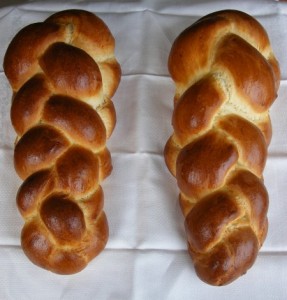
So what do the Swiss do on Sundays? It seems that many of them visit relatives and friends. Others spend weekends skiing in the mountains. They also eat a particular kind of bread on Sundays called Zopf. It is a braided bread that everyone buys on Saturday to eat on Sunday. Although I don’t always go shopping on Saturday, and sometimes we find ourselves without much selection in our kitchen. It’s a good thing the pizza delivery place in our town is open on Sundays! (Though it costs about $48 to get two pizzas delivered, so we try not to do it too often.)

When we are at home on a Sunday, I find myself at a loss. So, today I broke the law and vacuumed and did a bunch of laundry (though I don’t hang it outside). And then, we did what most other Americans do on Sundays, we fired up our Apple TV and watched football.

I’m feeling rebellious, so I think I’ll go flush the toilet before I go to bed.

It’s the Little Things – Movies and Kissing

Last night Joe came home from work and said that our friend Lorenz wanted to go to a movie. He was going to see Mission Impossible 4, which is not really Joe’s favorite kind of movie, so instead he came home and said he would stay with the kids if I wanted to go out. Are you kidding me! It was like a miracle. In fact, I’m a little embarrassed at how much I wanted to go out! You would think seeing an American movie in an urban movie theater would be a familiar experience, but once again, it was the little things that made it a cultural experience.

Movies

Surprisingly, the concession stand wasn’t even open when we arrived a few minutes before the start of the movie. My desire for a bubbly beverage was squashed. Oh well. We walked into the theater, and he led me to our assigned row and numbered seats. Yes, there were reserved seats at the movie theater, instead of first-come-first served seating, which seemed to make a lot of sense. Then, Lorenz informed me that there would be an intermission. Really? Sure enough, right as Tom Cruise was about to jump out a window of the tallest building in India, the screen went dark and the lights came up.

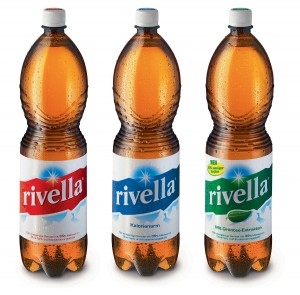
Fortunately this meant I could get my drink after all. I ordered a clear soda, and got a mineral water – something I am slowing growing to appreciate. Lorenz ordered a Rivella, an extremely popular Swiss soda that comes in three color varieties. He got Red. Oh, and the drinks don’t come in giant cups with a straw and lots of ice. In fact, you almost never get ice in Switzerland. If you ask for ice in your drink at a restaurant, the waiter usually looks worried, and then you get one or two cubes in a cup. In any case, at the movie theater, they simply handed us 16 oz bottles of our bubbly beverages, and we returned to our seats for the rest of the movie.

The movie was shown in the original English, which was great for me. But, in Switzerland there is not just one set of subtitles, but two – German on top and French on the bottom. Oh, and when the characters were speaking in Russian, then there were three lines, and I had to read the middle one. Once I adjusted to this, it was no problem, and we had a great night out.

Kissing

You’ve probably seen or encountered the European custom of cheek kissing, either on screen or in person. I think of it as being very French, but it occurs in many countries. I never thought much of it, but when you are confronted with it face to face, literally, it can be a little awkward. Think about it. Where do you put your hands? Which side do you kiss first? How many kisses – 2 or 3? If you do any of these things wrong, you can end up in a really embarrassing situation with someone whose face is one inch away from yours!

Fortunately, in Switzerland there is still a lot of hand shaking. And I do mean a lot. There is a custom of shaking hands with everyone at a party or gathering when you arrive, and again before you leave. This still occurs at a lot of meetings and social gatherings, even choir practice. Though in my experience, there is a limit of about 10 people before the greetings just get too cumbersome and stop.

Cheek kissing is reserved for people who are more than passing acquaintances. In a way that makes it even more confusing. Which greeting should I do!? There are just a small handful of people who have initiated this greeting with me. And, after some slightly embarrassing trial and error, I have learned that three kisses starting to the left side (right cheek) is customary here.

Though my favorite cheek kisser is Henry. He just puts his lips to my cheek and says “mmmmaa.” And it always makes me smile, no matter how many mistakes I’ve made that day.

Winter Wonderland

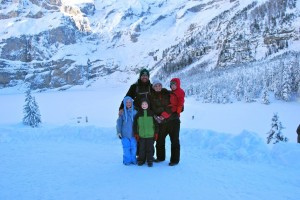
Our real Alpine vacation started after all the Christmas festivities were over. We had spent most of the weekend celebrating indoors, so when we awoke on Monday to a beautiful blue sky day, we had to take advantage of it. There are a lot of winter sports in this area, including downhill skiing, cross country skiing, snow shoeing, ice skating, and sledding. We decided to start slow, so we bundled everyone up, rented an additional sled and headed to the nearby gondola.

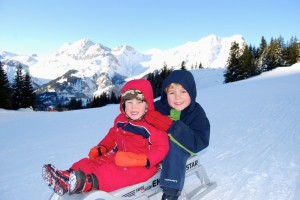
A the top of the mountain, we had to hike over to the top of the sled run, darting across ski slopes with downhill skiers rushing past. When we came to a section with a downward slope, we crammed 5 people onto 2 sleds and rode down to the chalet by the Öschinensee, a beautiful alpine lake nestled among the mountains at 5177 feet. It was at this point that we realized we still had a long ways to go to the bottom of the mountain, and that sledding in the Alps is not really a slower choice after all.

The next section of the sled run is incredibly steep and follows a ravine which is not blocked by any kind of fencing. We flew down, jamming our heels into the snow as hard as we could, which only slowed us down to 50 mph from 60 mph. Joe and Emily, who had a significant lead, tanked first. And just as they were brushing themselves off and getting back on the sled, I flew by with the boys screaming at the top of their lungs. Seconds later, we also wiped out, mostly becuase it was the only way I could find to stop the sled before crashing into a tree or going over the edge. Just ahead of us was a 120 degree turn onto a narrow bridge over a mountain stream. But, after a few more harrowing turns, the trail calmed down a bit, so that we could at least look up occasionally and enjoy the scenery as we were whizzing past it.

We decided it wouldn’t be prudent to bring Henry on that run again, but the other kids were willing to give it another go. So, we took turns doing it again, with a little more success on the second round.

That night, we slowed way down, and walked over to the lighted toboggan run (Schlittenbahn) in town, which is a fairly straight and well groomed run with lights strung above it. We went down it a couple of times, and then walked back to the hotel under the stars for a dinner of traditional Fondue and Raclette.

Tuesday morning started our skiing adventure. Joe took the older kids up the mountain for their first ski lesson while Henry and I stayed back and hiked and sledded in the valley. Emily and James struggled quite a bit to keep their skis from crossing, they fell down a lot, they worked hard getting across flat areas, and they came back sweaty and exhausted. When I asked them how it was they said, “Great!”

With their first lesson under their belts, we figured we could take them out the next morning on our own. So we got up early and took the whole family up to a quieter, easier mountain on the other side of town. It turns out, this was not a good idea. Although the scenery was beautiful and we snapped a couple of cute pictures, do not be decieved. It was an unmitigated disaster. I could write a whole post about the next three hours of skiing (if you can call it that), but I don’t really want to remember it. Let’s just say that skiing with young beginners is extremely hard work. There was a lot of yelling and whining, though no crying, which puts us ahead of most of the other beginner families we saw. But, technically, we can all say that we have skied in the Swiss Alps.

Christmas in the Alps

Spending Christmas away from family is a difficult thing. Every present we opened that had been shipped across the ocean was simultaneously exciting and depressing. We Skyped with many of our family members, which is bitter sweet. It was wonderful to see everyone and share holiday greetings, but hanging up (sometimes with tears) brought us back to our quiet hotel room again. But, since we are staying in a lovely hotel in Kandersteg, Switzerland in the heart of the Berner Oberland surrounded by the Alps, there are many beautiful things and new experiences to keep our minds from dwelling on home, and make this a Christmas to remember.

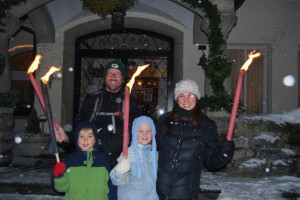
On Christmas Eve, the hotel had a torchlight walk through the woods. So, as the sunlight was fading away behind the mountains, we gathered with an international group of fellow guests, plopped Henry on his sled (his primary mode of transportation for the week), and received our flaming torches. Even Emily and James were given torches, along with a short lecture about fire safety. There was a light snow falling as we paraded toward the woods and away from the lights of the town, until we found ourselves among snow covered evergreen trees, with only torches to light our way. After a short walk, we stopped in a clearing and enjoyed some glühwein for the adults and hot apple cider for the children, before returning to the hotel.

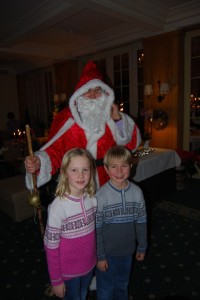
We had a lovely, 4-course Christmas Eve dinner in the hotel dining room, including cream of walnut soup, duck breast, and gingerbread ice cream. After dinner the Weihnachtsmann (German for Santa) came to visit all the children in the lobby and handed them each a small stocking filled with Swiss chocolate. This was something the hotel arranged for its primarily British clientele.

The Christmas tradition in Germany and Switzerland is for the Christkind, or Christ Child, to bring presents on Christmas Eve. Often represented by an angel, the Christkind comes when no children are in the room, and rings a bell to call them back, though the children never actually see him. So, back in our hotel room, the kids were playing with some of the toys they had received earlier that day when a bell rang in their bedroom. They looked at each other quizzically and then jumped up to see what it could be. They opened the door and there was a rush of cold air from an open window, which they looked out to catch a glimpse of a present-bearer, but there was no one there. Then they noticed some gifts left in the room, which they immediately got to open. It was our first visit from the Christkind.

We struggled to get the kids into their pajamas and said a prayer for our families so far away. We fell asleep to the ringing of church bells at the small alpine church next door calling worshipers to midnight mass.

White Christmas

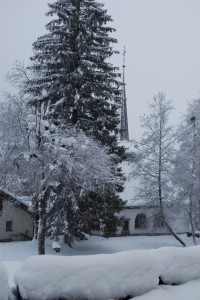
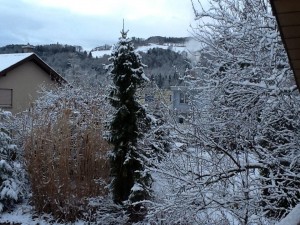
Snow has finally arrived! It started over the weekend, and has been falling on and off for about four days. As I write this, I am looking through our wall of windows at fluffy snowflakes falling into our backyard, covering trees and bushes with a picturesque white lining. It is truly a Winter Wonderland.

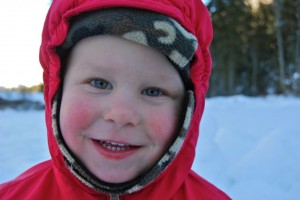
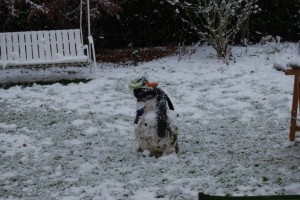
Remarkably, although it’s been snowing for several days, the accumulation is only a few inches. But that’s all it takes. Somehow a layer of snow makes our kids, who refused to go outside when it was a few degrees warmer, want to bundle up and build snowmen, throw snowballs, and just stick their tongues out and look skyward. (Or, if that doesn’t yield enough satisfaction, pick up a handful of snow and just eat it.) When they finally come in with rosy cheeks, we snuggle around our fireplace drinking hot cocoa.

The Swiss people love the snow and have been waiting for it longer than usual this year. They have a huge winter tourism season here as people come from all over the world to go skiing and experience a Swiss winter. And now we are starting to see why. I still have presents to wrap and packing to do, so for the moment I am content to enjoy the snow through my windows. I plan to light another fire, put on some Christmas music and sing “Let it Snow, let it snow, let it snow!”

Besides, this is good preparation for our Christmas in the Alps, where they have had snow for several weeks already. One of our favorite travel guides, Rick Steves, spent Christmas in the Alps a number of years ago. He stayed in Gimmelwald with Olle and Maria, just like we did back in October. Gimmelwald is a smaller town and more secluded setting than where we will be, but his video captures many Swiss things we have experienced, like sledding on traditional wooden toboggan sleds, eating fondue, reckless use of fire, and some Christmas traditions including Samichlaus and Schmutzli (not “Smoochli” as Rick Steves mistakenly pronounces it).

So, from snowy Switzerland, “Frohe Weihnachten!”

Holidays with a Swiss twist

It’s hard to believe that Christmas Eve is just one week away! During this past week, we experienced even more Swiss holiday traditions.

Emily had two notable field trips. The first was to the Bern Puppentheater where her class watched the Christmas story – the one with baby Jesus and Mary and Joseph – enacted with puppets. Puppet theaters are very European, as is bringing public school children to a religious show (on a train!). This morning, Emily’s class went ice skating at an indoor rink in the next town where they were given ice skating lessons. They will go ice skating twice more this winter to improve their skills.

On Thursday night, Emily’s school had Wintersauber, which is a social gathering where families come to see the crafts the children have made and hear them sing holiday songs. The singing took place outside where it was cold, dark, and crowded. To warm everyone up, there was mulled cider being served out of a cauldron over an open fire. It was BYOM – Bring Your Own Mug.

James is our little chef; he loves to help out in the kitchen. In his kindergarten, they do a surprising amount of baking. He has made traditional breads, snacks, and cookies. I, on the other hand, am not much of a baker, though I do have some favorite Christmas cookies we make back home. However, it has proven impossible to make the same cookies here as the ingredients aren’t available. So, today the kids and I attempted to make a couple of traditional Swiss Christmas cookies. Cookies are very different here than what we are used to. There are no chocolate chips to be found, no gingerbread, no sugar cookies. Swiss cookies are made with a lot of ground nuts (almonds and hazelnuts) and anise, their favorite flavoring (they even put it in toothpaste!). The most common holiday cookies are cinnamon stars or Zimtsterne. We also made Chräberli. Both recipes require a significant amount of setting time, so we won’t know how they turned out for a couple of days. If you want to give them a try, the recipes are here.

Tomorrow, Joe is giving me a “Mommy’s Day Off,” and I am planning to go to the Weihnachtsmarkt in Bern and see a holiday choral concert at the Cathedral. What a great early Christmas present!

Christmas is in the Air

My gift packages have been sent, our Christmas picture has been taken, and we’ve watched several Christmas specials on TV. Our decorations are up, minimal though they may be. But, this year we are adding some new experiences to our Christmas season.

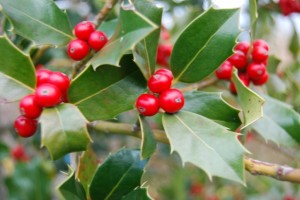
First, I have seen my first real holly tree. They are very common here for landscaping. I even snipped a few sprigs for my advent wreath and decorations. Did you know that holly leaves are extremely sharp? The prickers on each point of the leaves are like needles. Ouch! You can see a whole holly tree in our Christmas season photo gallery.

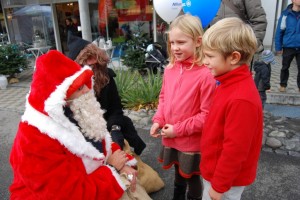
On Sunday, our town of Münsingen had a Weihnachtsmarkt or Christmas market. The streets were filled with with stands selling homemade trinkets, baked goods, and other seasonal items. I finally had my first glass of glühwein. Samichlaus (the Swiss Santa Claus) and his sidekick Schmutzli were walking the streets handing out the traditional gifts of nuts, clementines, and chocolates to any children who do a little song or poem for him. Unaware of this requirement, Emily and James approached him in hopes of free loot, but found themselves singing “Jingle Bells” in front of a crowd of onlookers.

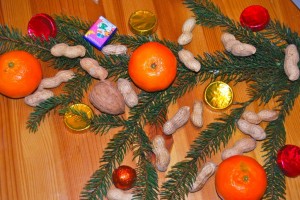
Yesterday, December 6th, was St. Nicholas Day, which is an important part of the Christmas season in Switzerland. As usual, we did it wrong. I grew up with St. Nicholas coming on the night of December 5th and filling our stockings. We don’t have stockings, so the kids left out their shoes (actually they left their rain boots, reasoning that they are bigger and would fit more stuff!). They woke up on the morning of the 6th to find them filled with little treats. But, in Switzerland, St. Nick doesn’t come until the evening of the 6th. Oops. During the day, he visited the schools where both Emily and James received a bag of nuts, chocolates, and clementines. Then, he visits family celebrations in the evening.

I went to choir practice that night, and we sang a beautiful arrangement of “Stille Nacht” as well as other pieces we are preparing for the Christmas service. I was surprised to see tables of – that’s right – clementines, nuts and chocolates, as well as tea, wine, and home made treats. We ended our practice a little early and sat down to share some holiday gemütlichkeit.

The Christmas spirit is definitely in the unseasonably warm air. Now, if only the rain outside would turn to snow…

It’s the Little Things – Calendars and Garbage

Today was just another normal day for us in Switzerland. In many ways, our life here is similar to what it was in America – kids go to school, Joe goes to work, there is housework, playdates, homework, shopping. And yet, there are so many little ways in which it is different. And when all the little differences are added up, it gives a picture of what it means to live in another culture and country. So, this is the first of an occasional series I call “It’s the Little Things” that will highlight some of the ways things are different here.

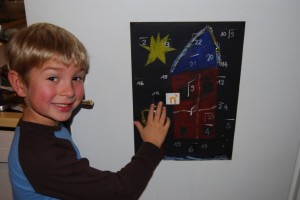
Advent Calendars – I’ve seen Advent calendars in America. In fact, we have one that has 24 felt characters that go onto a manger scene. But, here, Advent calendars are everywhere. Counting down from December 1st to the 24th is an important part of the Christmas season. The Brumanns, our friends from Basel, sent each of our kids an Advent calendar with paper doors that open to reveal pictures. They said their children used to have them every year and always looked forward to opening the doors. I didn’t think opening little one-inch square doors to see a picture would be that exciting, but my kids love them! They can hardly wait to open the next door. James also made another one at school with his own pictures behind each of the doors. Since today was December 1st, the kids finally got to open the first doors, and for the next 23 days, they will giddily open four doors on our Advent calendars, just like Swiss children have done for generations.

At school, the kids also have a form of an Advent calendar. There are small gifts for every school day between now and Christmas, and every day they pick the name of a student out of a bag. The lucky child gets to select a gift to open and keep.

Garbage – I know, I know… who wants to read about garbage?! But, I actually think the handling of garbage is a window into cultural values.

There are 7 categories of garbage here: plastic recyclables, paper recyclables, other recyclables, yard waste, compostable garbage, bread, and everything else. Regular garbage goes into specific mandatory municipal garbage bags that are available at the store, and are priced not just for the bags themselves, but for the volume of garbage they hold. Since garbage collection is not paid for entirely by taxes here, this is one of the ways they cover the costs while encouraging people to limit their waste.

Limiting waste is important here, and there are many ways people do this, but my favorite involves old bread. We’ve mentioned before that nearly all the bread is fresh bakery bread that only lasts for about 36 hours, which not only means that we have to buy bread just about every day, but it also means there can be a lot of rock hard bread crusts and end pieces left over. Interestingly, the bread does not mold, it just gets hard. Our landlady gave us specific instructions about what to do with all of our bread scraps: “feed them to the ducks.” So, about once a week, we go on an expedition looking for ducks on one of the creeks near our house. And today we hit the jackpot! While Emily was at school in the afternoon, James and Henry and I found about 40 ducks eager to eat our bread crumbs. So eager they were even jumping up on the steps where we were sitting. A couple times, they snatched pieces right out of James’s hands. It was the highlight of our afternoon. (Meanwhile, I gave Emily 4 Swiss Francs, and on her way home from school, she stopped in the local family-run butcher shop/market and bought a loaf of bread to bring home. I love that my 7-year-old can do that!)

There are no garbage disposals here, but throwing biodegradable food waste in the garbage is not ideal. Many people, including us, put food waste into a compost bin. Ours is outside next to our garden. Any outdoor waste that is too big for the compost bin goes in the green plastic garbage container for industrial compost that gets picked up occasionally, though I haven’t figured out exactly when. My goal has always been to fill the green container every time, as there is a lot of pruning and weeding that goes on to maintain the extensive gardens here.

In order to recycle things like glass, metal, batteries, etc. we have to haul it (by bike, of course) to a recycling station about 4 blocks from our house and sort it into the appropriate materials and colors. Plastic bottles go to a different recycling station by the grocery store. Paper must be tied up with string or put in paper bags and put out at the curb every other Monday.

Joe tells me that the the Inselspital where he works burns all of its garbage in a special
incinerator that generates power back to the hospital. No waste there!

The fact that these systems work so well here, especially the recycling and required garbage bags, is a testament to Swiss reliability, morality, and environmental consciousness. When they are told to do something, they do it. And for now, so do we.