Over the Hump

This past weekend we were lucky enough to be invited to stay with some friends of ours who have a house in the mountain town of Lenk, during which we got “over the hump” both physically and metaphorically. See, we have been debating about whether our family is really cut out for skiing at this stage. Emily and James have had virtually no experience, and our first effort over Christmas was not enjoyable for anyone. But, the family we stayed with has been coming to this valley and skiing their whole lives. So, we had no choice but to go with the flow.
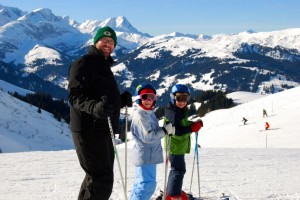
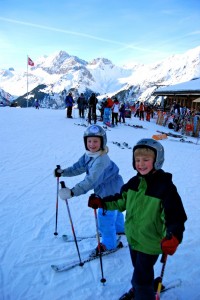
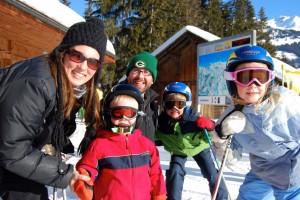
On Saturday morning we all got geared up and headed over to the first ski area. They even had skis in Henry’s size and insisted he should suit up with the rest of us. We got to the top of the lifts, and skied down the first hill. I was holding Henry, who was screaming the whole way down. He was pretty much done for the day. But everyone else took off with enough adults to help. After lunch I got to ski down with Emily (holding her between my legs for most of a medium run) until we got to the kids area or “bunny hill,” as my family calls it. We skied for a couple more hours, with the adults taking turns staying with the kids. This was far longer than we have ever managed before. By the end of the day, the kids had made a lot of progress, but we were all pretty exhausted. Fortunately, there was a gondola to take us back down the hill and a great swimming pool complex where Joe and I took all the kids to unwind.

That night, another family joined us at the house, so there were two Swiss families with spouses from Sweden and Namibia and us. Everyone mostly spoke English, but we understood what they said in Swiss German as well. They complimented our kids, and even us, on our ability with the language. We kept up with a conversation about Swiss cultural quirks and compared the virtues of the two primary Swiss grocery store chains. Though it seems small, I felt like we had really gotten over a cultural “hump” and were no longer the outsiders.
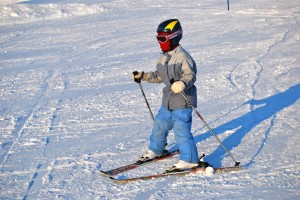
On Sunday, we were off again. After a scary ride up an icy mountain road on which the direction of the one-way traffic changes every half hour, we made it to the ski area on the other side of the valley. I stayed in with Henry and played in the snow for most of the morning, and Joe was able to take both Emily and James on his own and help them as they skied independently. This was huge! They had clearly gotten over a critical hump in their ability, and they started to become more confident.
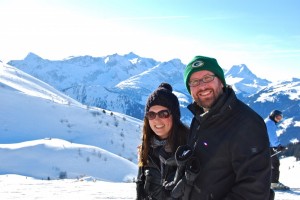
After lunch, Lorenz offered to stay with our kids so Joe and I could explore a bit. We literally went over the mountain and down to Adelboden in the valley on the opposite side. We humiliated ourselves on a black run that was directly below one of the busiest chair lifts, but fortunately no one was hurt, so we’ll just gloss over that. Otherwise, we had a wonderful time and returned to our kids just as the lifts were starting to close down. The mountain had mostly cleared out, and this time there was no gondola to ride down. The only way to get to the car was to ski down the mountain.

Lorenz was nice enough to carry Henry down (we didn’t even bother to put his skis on anymore). Joe and I followed with the other kids, and I am proud to say that they did a great job. We were the only people on the mountain as we snowplowed slowly back and forth down the slope. My heart was swelling as I watched my kids skiing on their own as the sun was setting behind the mountains across the valley. It was a moment I will never forget.

So maybe, just maybe, we can be a skiing family after all.
Photos of our skiing weekend.

Breaking the Law

Sundays in Switzerland are very quiet. And that is how they like it. In fact, there are a number of customs and some actual laws to help keep it that way. For starters, it is illegal to employ staff on Sundays, which is why most stores are closed. There are, of course, some exceptions, but generally there is no grocery shopping or shopping of any kind on Sundays. It is also illegal to hang laundry outside or wash your car on a Sunday. It is considered an offense to mow your lawn or vacuum on a Sunday, or generally do anything that makes too much noise.

Many of these laws are in place because most Swiss people live in apartment complexes and share walls and plumbing with other people. Incidently, it is also illegal to flush the toilet after 10pm.

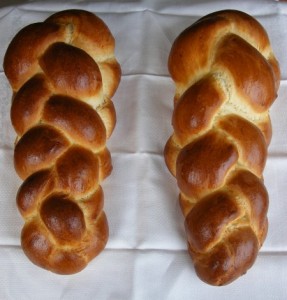
So what do the Swiss do on Sundays? It seems that many of them visit relatives and friends. Others spend weekends skiing in the mountains. They also eat a particular kind of bread on Sundays called Zopf. It is a braided bread that everyone buys on Saturday to eat on Sunday. Although I don’t always go shopping on Saturday, and sometimes we find ourselves without much selection in our kitchen. It’s a good thing the pizza delivery place in our town is open on Sundays! (Though it costs about $48 to get two pizzas delivered, so we try not to do it too often.)

When we are at home on a Sunday, I find myself at a loss. So, today I broke the law and vacuumed and did a bunch of laundry (though I don’t hang it outside). And then, we did what most other Americans do on Sundays, we fired up our Apple TV and watched football.

I’m feeling rebellious, so I think I’ll go flush the toilet before I go to bed.

It’s the Little Things – Movies and Kissing

Last night Joe came home from work and said that our friend Lorenz wanted to go to a movie. He was going to see Mission Impossible 4, which is not really Joe’s favorite kind of movie, so instead he came home and said he would stay with the kids if I wanted to go out. Are you kidding me! It was like a miracle. In fact, I’m a little embarrassed at how much I wanted to go out! You would think seeing an American movie in an urban movie theater would be a familiar experience, but once again, it was the little things that made it a cultural experience.

Movies

Surprisingly, the concession stand wasn’t even open when we arrived a few minutes before the start of the movie. My desire for a bubbly beverage was squashed. Oh well. We walked into the theater, and he led me to our assigned row and numbered seats. Yes, there were reserved seats at the movie theater, instead of first-come-first served seating, which seemed to make a lot of sense. Then, Lorenz informed me that there would be an intermission. Really? Sure enough, right as Tom Cruise was about to jump out a window of the tallest building in India, the screen went dark and the lights came up.

Fortunately this meant I could get my drink after all. I ordered a clear soda, and got a mineral water – something I am slowing growing to appreciate. Lorenz ordered a Rivella, an extremely popular Swiss soda that comes in three color varieties. He got Red. Oh, and the drinks don’t come in giant cups with a straw and lots of ice. In fact, you almost never get ice in Switzerland. If you ask for ice in your drink at a restaurant, the waiter usually looks worried, and then you get one or two cubes in a cup. In any case, at the movie theater, they simply handed us 16 oz bottles of our bubbly beverages, and we returned to our seats for the rest of the movie.

The movie was shown in the original English, which was great for me. But, in Switzerland there is not just one set of subtitles, but two – German on top and French on the bottom. Oh, and when the characters were speaking in Russian, then there were three lines, and I had to read the middle one. Once I adjusted to this, it was no problem, and we had a great night out.

Kissing

You’ve probably seen or encountered the European custom of cheek kissing, either on screen or in person. I think of it as being very French, but it occurs in many countries. I never thought much of it, but when you are confronted with it face to face, literally, it can be a little awkward. Think about it. Where do you put your hands? Which side do you kiss first? How many kisses – 2 or 3? If you do any of these things wrong, you can end up in a really embarrassing situation with someone whose face is one inch away from yours!

Fortunately, in Switzerland there is still a lot of hand shaking. And I do mean a lot. There is a custom of shaking hands with everyone at a party or gathering when you arrive, and again before you leave. This still occurs at a lot of meetings and social gatherings, even choir practice. Though in my experience, there is a limit of about 10 people before the greetings just get too cumbersome and stop.

Cheek kissing is reserved for people who are more than passing acquaintances. In a way that makes it even more confusing. Which greeting should I do!? There are just a small handful of people who have initiated this greeting with me. And, after some slightly embarrassing trial and error, I have learned that three kisses starting to the left side (right cheek) is customary here.

Though my favorite cheek kisser is Henry. He just puts his lips to my cheek and says “mmmmaa.” And it always makes me smile, no matter how many mistakes I’ve made that day.

Small Christmas Miracles

James has been having a bit of a difficult Christmas. He’s admitted to being pretty homesick, and I think that the holidays coming on were making him think more of home. More than that, though, James became convinced this year that Santa wasn’t real. And this wasn’t just a fleeting thought. He would argue about it. He would yell at his sister about it. He would get upset when anyone suggested otherwise.

So Sarah and I talked to him. We pulled him aside and said we thought it was fine if he didn’t want to believe in Santa Claus. He told us that he thought we were the ones who brought presents on Christmas. We told him that was true. But we also told him that it was important to his younger brother and older sister that Santa really existed. So we said that, for now, we would not discuss whether Santa existed in front of Emily and Henry, unless they wanted to talk about it too. He was OK with that.

Then we went on our Christmas Vacation in the Alps and a few small things happened. First, while enjoying our presents on Christmas Eve, a small bell rang from the next room, when the kids went in they found a few more presents and evidence that the Christkind had been there.

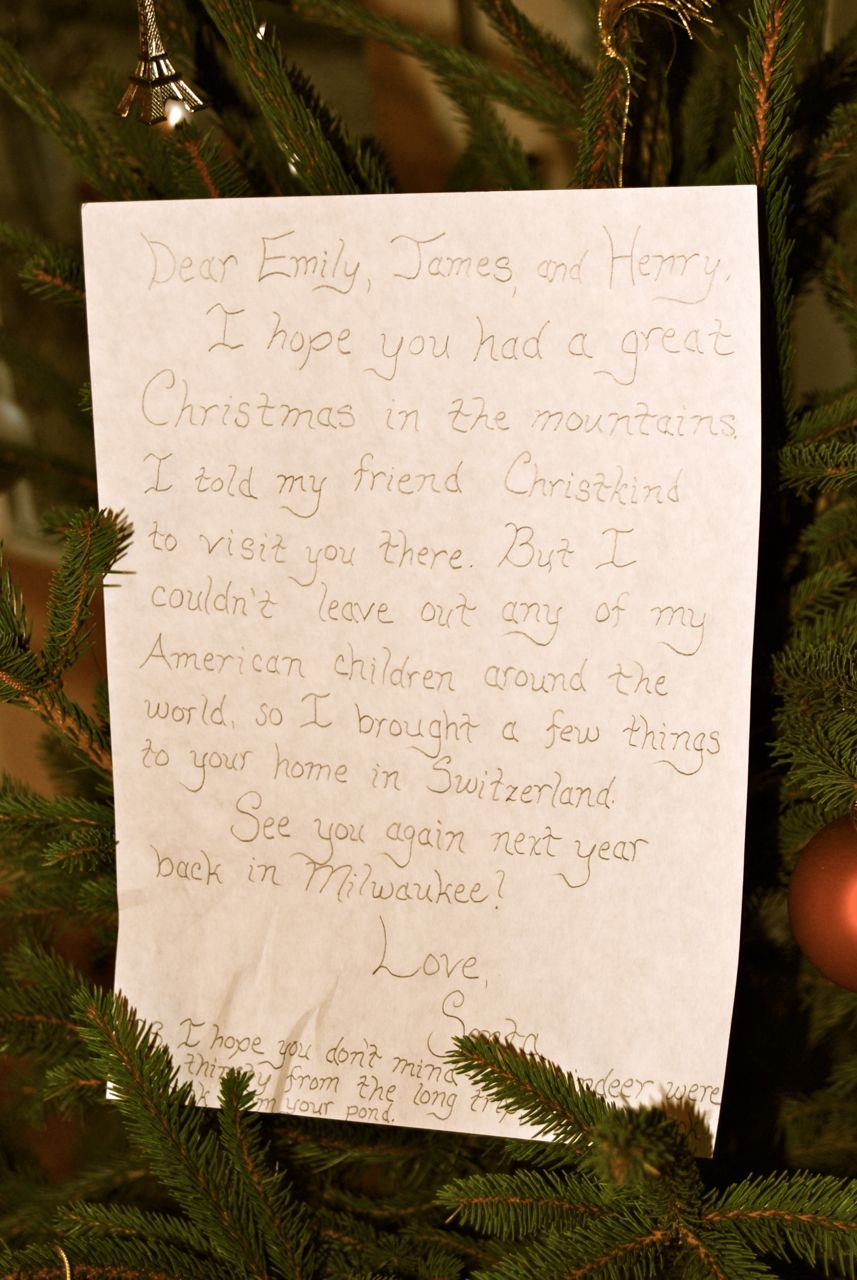
Santa's note on our tree

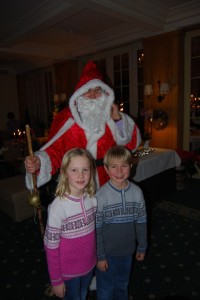
That night, at dinner, the Weihnachtsmann visited. The kids were suspicious of this man, but he pulled me aside, and asked me if I knew an Emily and James. I told him I did. He handed me two packages and told me that they contained a very special Swiss treat only for boys and girls who were ready to accept them. The Weihnachtsmann had singled out Emily and James.

Finally, when we arrived home in Münsingen, we found our fireplace open. There were bootprints and ashes around our tree. James detected hoof prints in the backyard. Most importantly, there were presents under our well-cared for and watered Christmas tree. There was also a note on the tree that read:

Dear Emily, James, and Henry,

I hope you had a great Christmas in the mountains. I told my friend Christkind to visit you there. But I couldn’t leave out any of my American children around the world, so I brought a few things to your home in Switzerland.

See you next year back in Milwaukee!

Love,
Santa

P.S. I hope you don’t mind – the reindeer were very thirsty from the long trip, so they took a drink from your pond.

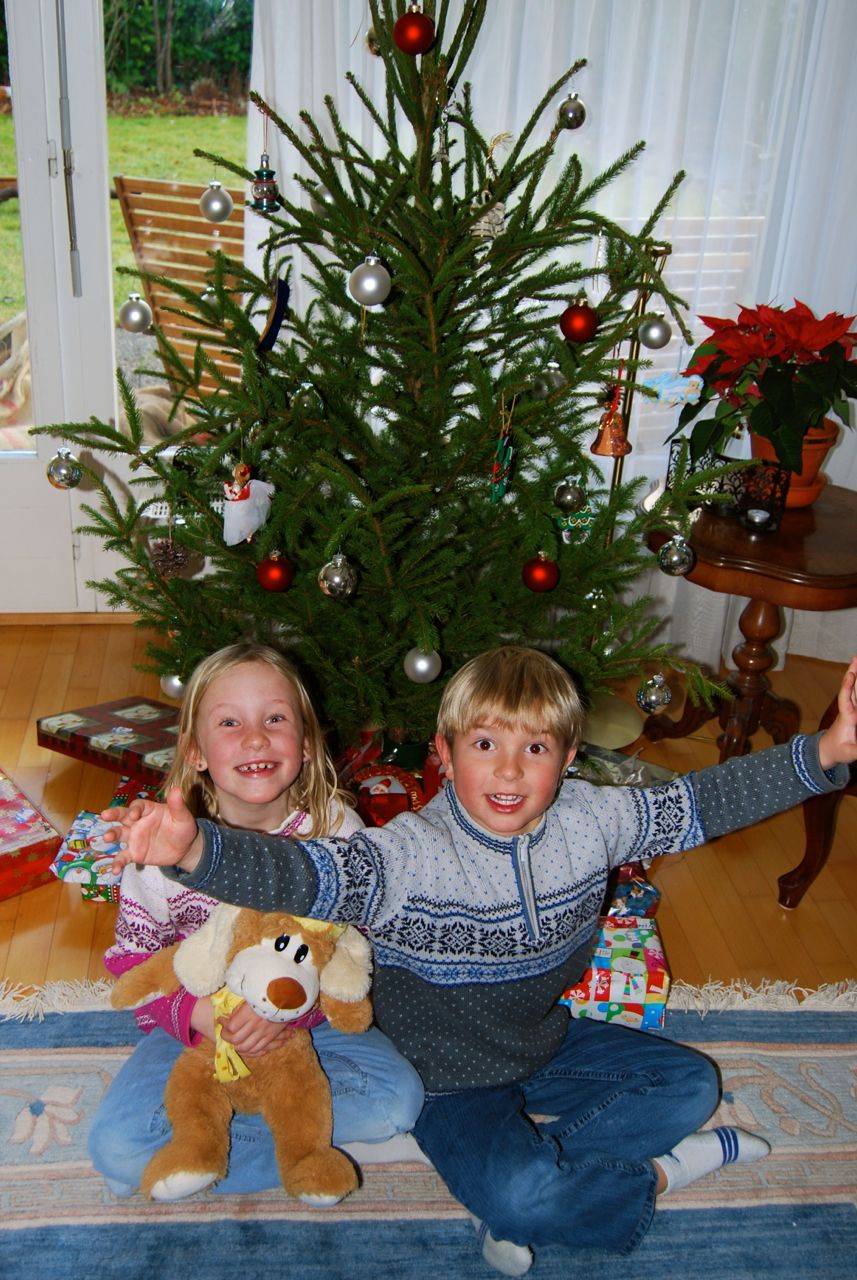
The Kids can't believe that Santa came!

James, Emily, and Henry all jumped around the room yelling that they couldn’t believe it! Santa had come to visit them in Switzerland. James told Sarah and I that he couldn’t believe that he was wrong about Santa. Then he told us he couldn’t believe that we were wrong about Santa, too.

We agree. How amazing it can be to believe again.

Winter Wonderland

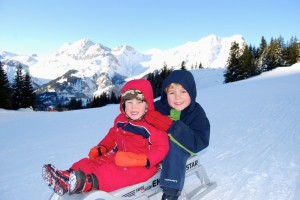
Our real Alpine vacation started after all the Christmas festivities were over. We had spent most of the weekend celebrating indoors, so when we awoke on Monday to a beautiful blue sky day, we had to take advantage of it. There are a lot of winter sports in this area, including downhill skiing, cross country skiing, snow shoeing, ice skating, and sledding. We decided to start slow, so we bundled everyone up, rented an additional sled and headed to the nearby gondola.

A the top of the mountain, we had to hike over to the top of the sled run, darting across ski slopes with downhill skiers rushing past. When we came to a section with a downward slope, we crammed 5 people onto 2 sleds and rode down to the chalet by the Öschinensee, a beautiful alpine lake nestled among the mountains at 5177 feet. It was at this point that we realized we still had a long ways to go to the bottom of the mountain, and that sledding in the Alps is not really a slower choice after all.

The next section of the sled run is incredibly steep and follows a ravine which is not blocked by any kind of fencing. We flew down, jamming our heels into the snow as hard as we could, which only slowed us down to 50 mph from 60 mph. Joe and Emily, who had a significant lead, tanked first. And just as they were brushing themselves off and getting back on the sled, I flew by with the boys screaming at the top of their lungs. Seconds later, we also wiped out, mostly becuase it was the only way I could find to stop the sled before crashing into a tree or going over the edge. Just ahead of us was a 120 degree turn onto a narrow bridge over a mountain stream. But, after a few more harrowing turns, the trail calmed down a bit, so that we could at least look up occasionally and enjoy the scenery as we were whizzing past it.

We decided it wouldn’t be prudent to bring Henry on that run again, but the other kids were willing to give it another go. So, we took turns doing it again, with a little more success on the second round.

That night, we slowed way down, and walked over to the lighted toboggan run (Schlittenbahn) in town, which is a fairly straight and well groomed run with lights strung above it. We went down it a couple of times, and then walked back to the hotel under the stars for a dinner of traditional Fondue and Raclette.

Tuesday morning started our skiing adventure. Joe took the older kids up the mountain for their first ski lesson while Henry and I stayed back and hiked and sledded in the valley. Emily and James struggled quite a bit to keep their skis from crossing, they fell down a lot, they worked hard getting across flat areas, and they came back sweaty and exhausted. When I asked them how it was they said, “Great!”

With their first lesson under their belts, we figured we could take them out the next morning on our own. So we got up early and took the whole family up to a quieter, easier mountain on the other side of town. It turns out, this was not a good idea. Although the scenery was beautiful and we snapped a couple of cute pictures, do not be decieved. It was an unmitigated disaster. I could write a whole post about the next three hours of skiing (if you can call it that), but I don’t really want to remember it. Let’s just say that skiing with young beginners is extremely hard work. There was a lot of yelling and whining, though no crying, which puts us ahead of most of the other beginner families we saw. But, technically, we can all say that we have skied in the Swiss Alps.

Christmas Day: Pain and the Pelzmartiga

Christmas can be a real pain in the neck. Kids can be a real pain in the neck. Traveling during the holidays can be a real pain in the neck. Buying over-the-counter medications in Europe can be a real pain in the neck. Which is why, on Christmas Day, in Kandersteg Switzerland, I found myself in a doctors office explaining that I needed some anti-inflammatory medication because I had a real bad pain in my neck.

I’m not trying to complain here, but Christmas morning I woke up and was virtually unable to turn my head. I could look down okay, but looking up or to the sides was impossible. I knew what was going on, and I knew I just needed some Aleve to help it… but we didn’t have any. So I had to walk a couple blocks on Christmas morning to the local doctor so he could examine me and recommend some anti-inflammatory medication.

“You live in Switzerland?” he asked when I showed my Swiss health insurance card. “Yes. I live near Bern.” “Where do you work?” he asked me. “At the Inselspital,” I answered. “You’re a doctor?” he asked chuckling slightly. “Yep.” “What kind?” “Orthopaedics.” He now moved to a full on laugh. “I know,” I said, “this is all very silly.”

But I was thankful to have him there, and have learned more about the Swiss Health Care System in the meantime. Either way, by the end of the night I was beginning to feel better, and by the day after Christmas I could almost move normally again.

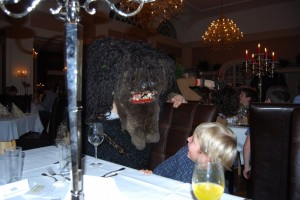
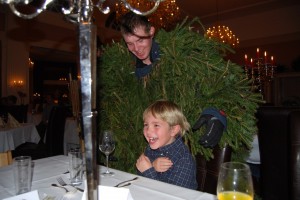
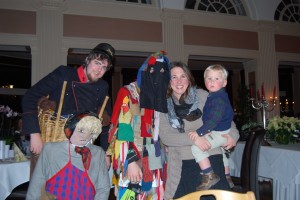
It turns out that Christmas in Switzerland has a contingency plan for this sort of thing. The Swiss have a tradition called the Pelzmartiga that is intended to ward off poor health, poverty, war, and danger. And they do this by trying to scare them away. So as we sat at Christmas dinner, an elegant 5-course meal with our children, we suddenly heard banging as though someone was dropping lots of pots and pans in the kitchen.

Instead, it turned out to be a group of citizens from the village, dressed up in traditional Pelzmartiga costumes, banging cowbells with old iron hooks. The walked into the hotel restaurant, mingled among the patrons alternatively scaring and consoling the children, and created the greatest ruckus I have ever heard at a Christmas dinner. To quote Henry: “They are very, very, loud.” Within ten minutes they were gone, and the children were beginning to calm down. But the impression will last a lifetime. Nothing caps off Christmas like a good scare!

Reading more about it, and speaking to locals, the Pelzmartiga are made up of the following characters:

  • The Chindlifrässer (Child Eater) wears a mask with a gaping mouth and menacing teeth. He carries a backpack with legs dangling out of it. The legs belong to a child that has fallen victim to him. The Chindlfrässer scares away famine and disease which, until the last century, caused the deaths of many young children.
  • The Chriismarti is dressed in evergreen branches and symbolizes the many dangers presented to men by winter in the woods.
  • The Blätzlibueb wears a gown of sheer fabric scraps to scare away poverty.
  • The Huttefroueli looks like an old woman carrying a war-torn soldier in a basket on her back. She scares away the threat of war.
  • The Spielkartenmann, covered all over with playing cards scares away desires to gamble and imprudent spending.
  • The Burli, a simple villager with pipe and nightcap. That’s all I could find out about that guy.
  • The Lyrimaa plays a hurdy-gurdy. You can throw money into its money slot to buy your freedom from evil powers.
  • The Heri, a gentleman in a tuxedo, hat, and white gloves holds a whip which he uses to keep the wild gang together and disciplines them if they become to violent.

Christmas in the Alps

Spending Christmas away from family is a difficult thing. Every present we opened that had been shipped across the ocean was simultaneously exciting and depressing. We Skyped with many of our family members, which is bitter sweet. It was wonderful to see everyone and share holiday greetings, but hanging up (sometimes with tears) brought us back to our quiet hotel room again. But, since we are staying in a lovely hotel in Kandersteg, Switzerland in the heart of the Berner Oberland surrounded by the Alps, there are many beautiful things and new experiences to keep our minds from dwelling on home, and make this a Christmas to remember.

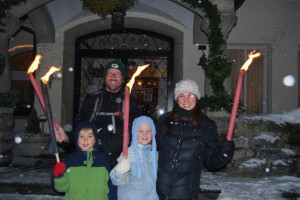
On Christmas Eve, the hotel had a torchlight walk through the woods. So, as the sunlight was fading away behind the mountains, we gathered with an international group of fellow guests, plopped Henry on his sled (his primary mode of transportation for the week), and received our flaming torches. Even Emily and James were given torches, along with a short lecture about fire safety. There was a light snow falling as we paraded toward the woods and away from the lights of the town, until we found ourselves among snow covered evergreen trees, with only torches to light our way. After a short walk, we stopped in a clearing and enjoyed some glühwein for the adults and hot apple cider for the children, before returning to the hotel.

We had a lovely, 4-course Christmas Eve dinner in the hotel dining room, including cream of walnut soup, duck breast, and gingerbread ice cream. After dinner the Weihnachtsmann (German for Santa) came to visit all the children in the lobby and handed them each a small stocking filled with Swiss chocolate. This was something the hotel arranged for its primarily British clientele.

The Christmas tradition in Germany and Switzerland is for the Christkind, or Christ Child, to bring presents on Christmas Eve. Often represented by an angel, the Christkind comes when no children are in the room, and rings a bell to call them back, though the children never actually see him. So, back in our hotel room, the kids were playing with some of the toys they had received earlier that day when a bell rang in their bedroom. They looked at each other quizzically and then jumped up to see what it could be. They opened the door and there was a rush of cold air from an open window, which they looked out to catch a glimpse of a present-bearer, but there was no one there. Then they noticed some gifts left in the room, which they immediately got to open. It was our first visit from the Christkind.

We struggled to get the kids into their pajamas and said a prayer for our families so far away. We fell asleep to the ringing of church bells at the small alpine church next door calling worshipers to midnight mass.

White Christmas

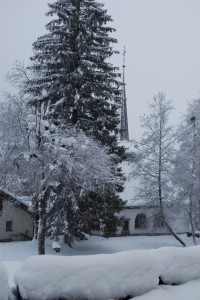
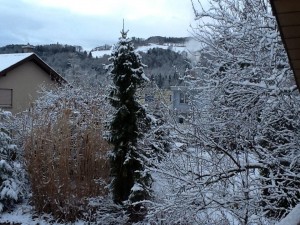
Snow has finally arrived! It started over the weekend, and has been falling on and off for about four days. As I write this, I am looking through our wall of windows at fluffy snowflakes falling into our backyard, covering trees and bushes with a picturesque white lining. It is truly a Winter Wonderland.

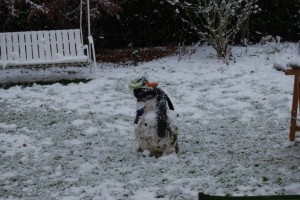
Remarkably, although it’s been snowing for several days, the accumulation is only a few inches. But that’s all it takes. Somehow a layer of snow makes our kids, who refused to go outside when it was a few degrees warmer, want to bundle up and build snowmen, throw snowballs, and just stick their tongues out and look skyward. (Or, if that doesn’t yield enough satisfaction, pick up a handful of snow and just eat it.) When they finally come in with rosy cheeks, we snuggle around our fireplace drinking hot cocoa.

The Swiss people love the snow and have been waiting for it longer than usual this year. They have a huge winter tourism season here as people come from all over the world to go skiing and experience a Swiss winter. And now we are starting to see why. I still have presents to wrap and packing to do, so for the moment I am content to enjoy the snow through my windows. I plan to light another fire, put on some Christmas music and sing “Let it Snow, let it snow, let it snow!”

Besides, this is good preparation for our Christmas in the Alps, where they have had snow for several weeks already. One of our favorite travel guides, Rick Steves, spent Christmas in the Alps a number of years ago. He stayed in Gimmelwald with Olle and Maria, just like we did back in October. Gimmelwald is a smaller town and more secluded setting than where we will be, but his video captures many Swiss things we have experienced, like sledding on traditional wooden toboggan sleds, eating fondue, reckless use of fire, and some Christmas traditions including Samichlaus and Schmutzli (not “Smoochli” as Rick Steves mistakenly pronounces it).

So, from snowy Switzerland, “Frohe Weihnachten!”

Korean Diplomacy

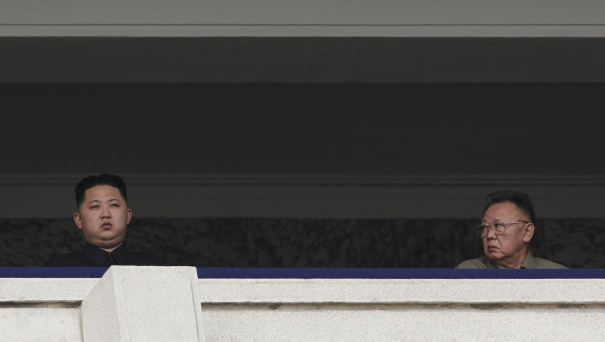
Kim Jong Un
Wie gehts, euch?

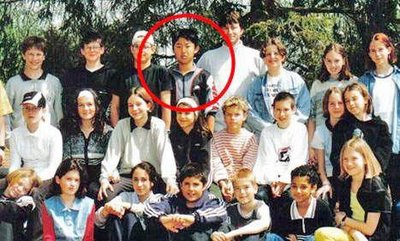
While this seems to be quite unrelated to the normally festive holiday season here, news of Kim Jong Il’s death, and the succession of his son to the leader of North Korea has been cause for a lot of news coverage here in Switzerland. Obviously, it’s been a huge news story everywhere, but what you might not know is that Kim Jong Un, the new leader of North Korea, lived and studied here in Bern. Actually, to be specific, he lived on the outskirts of Bern and went to school at the International School just two towns over from where we live.

Kim Jong Un in Gumligen
Kim Jong Un in a class photo in Gumligen

So the new leader of North Korea speaks Schweizer Deutsch. Kim Jong Il’s father, Kim Il-Sung, who ruled North Korea from 1948 to 1994 was known as the Respected Leader. Kim Jong Il was known as the Dear Leader. I suppose Kim Jong Un will be known, simply, as lederhosen.

Holidays with a Swiss twist

It’s hard to believe that Christmas Eve is just one week away! During this past week, we experienced even more Swiss holiday traditions.

Emily had two notable field trips. The first was to the Bern Puppentheater where her class watched the Christmas story – the one with baby Jesus and Mary and Joseph – enacted with puppets. Puppet theaters are very European, as is bringing public school children to a religious show (on a train!). This morning, Emily’s class went ice skating at an indoor rink in the next town where they were given ice skating lessons. They will go ice skating twice more this winter to improve their skills.

On Thursday night, Emily’s school had Wintersauber, which is a social gathering where families come to see the crafts the children have made and hear them sing holiday songs. The singing took place outside where it was cold, dark, and crowded. To warm everyone up, there was mulled cider being served out of a cauldron over an open fire. It was BYOM – Bring Your Own Mug.

James is our little chef; he loves to help out in the kitchen. In his kindergarten, they do a surprising amount of baking. He has made traditional breads, snacks, and cookies. I, on the other hand, am not much of a baker, though I do have some favorite Christmas cookies we make back home. However, it has proven impossible to make the same cookies here as the ingredients aren’t available. So, today the kids and I attempted to make a couple of traditional Swiss Christmas cookies. Cookies are very different here than what we are used to. There are no chocolate chips to be found, no gingerbread, no sugar cookies. Swiss cookies are made with a lot of ground nuts (almonds and hazelnuts) and anise, their favorite flavoring (they even put it in toothpaste!). The most common holiday cookies are cinnamon stars or Zimtsterne. We also made Chräberli. Both recipes require a significant amount of setting time, so we won’t know how they turned out for a couple of days. If you want to give them a try, the recipes are here.

Tomorrow, Joe is giving me a “Mommy’s Day Off,” and I am planning to go to the Weihnachtsmarkt in Bern and see a holiday choral concert at the Cathedral. What a great early Christmas present!